
BepiColombo probe reaches Mercury orbit and begins mission
The ESA confirms that the BepiColombo spacecraft has entered Mercury’s orbit. In December, two modules will separate, with full orbital operations beginning in 2027.
BepiColombo probe reaches Mercury orbit and begins mission
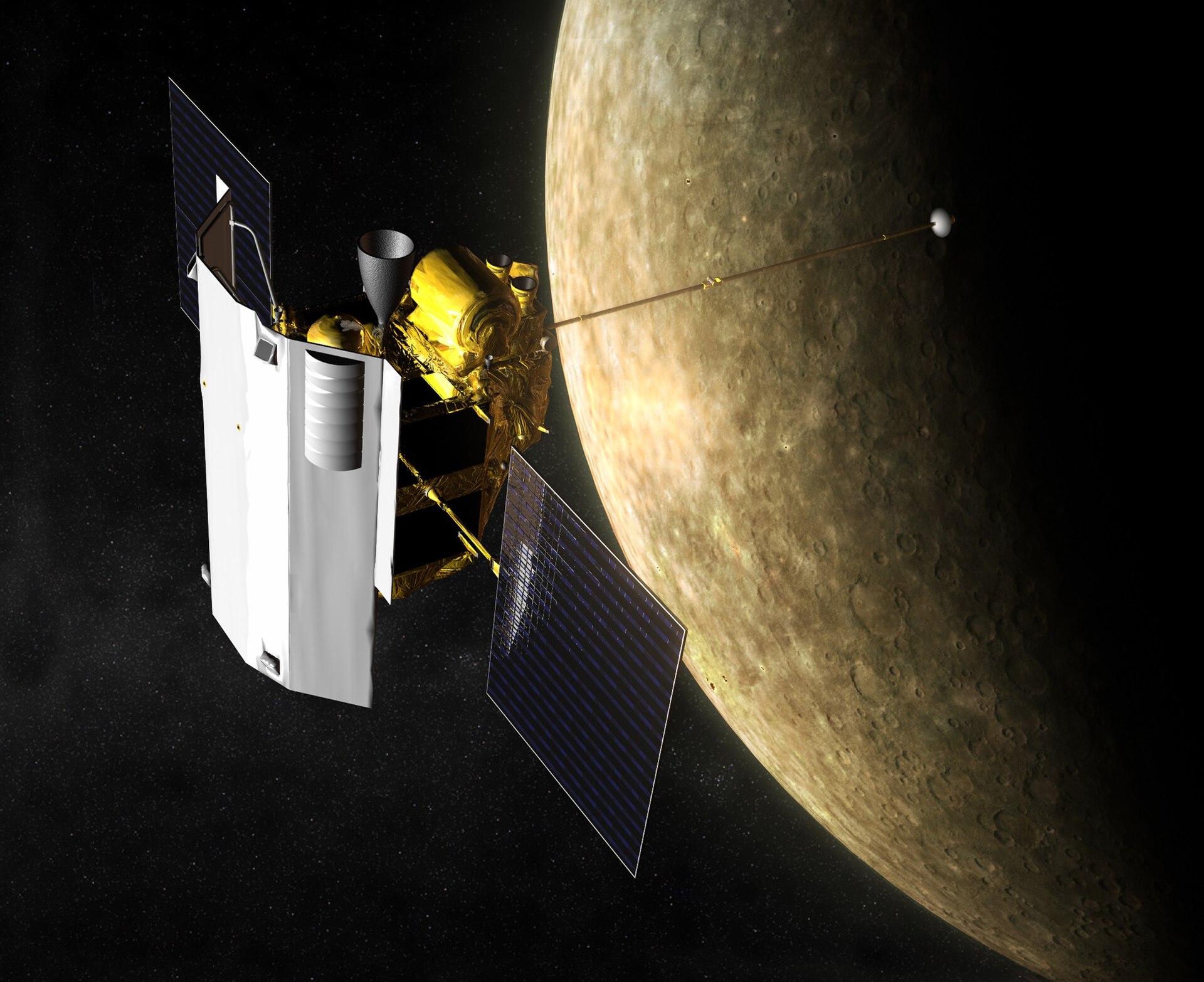
The European Space Agency (ESA) announced that the BepiColombo spacecraft reached Mercury’s region, marking the end of the approach phase and the start of the mission's critical operations in a joint effort with the Japanese space agency JAXA, according to ANSA.
Arrival and announcement: BepiColombo at Mercury
ESA communicated in a post on X that the BepiColombo spacecraft achieved its final objective after the long journey that brought it to the planet closest to the Sun. The mission is a partnership between the ESA and the JAXA, aimed at studying both Mercury’s surface and its magnetic and plasma environment.
History and journey of the BepiColombo spacecraft
Launched on October 20, 2018, BepiColombo undertook a complex nearly eight-year voyage, with multiple flybys of Venus and Earth to adjust its trajectory. During the traversal, the transfer module, named the Mercury Transfer Module (MTM), used electric propulsion to gradually reduce speed and enable the final insertion of the mission into Mercury’s vicinity. As reported by ANSA, separation steps and final maneuvers were completed at the end of 2026.
Mission structure and next steps: MPO and Mio
The mission carries two scientific orbiters: the Mercury Planetary Orbiter (MPO), developed by ESA, and the Mercury Magnetospheric Orbiter (Mio), developed by JAXA. The final separation of the orbital modules was planned for early December 2026 (ANSA indicated dates in early December 2026 for these operations). After separation:

- The MPO will focus its studies on Mercury’s geology, composition, and internal structure, using cameras, spectrometers, and geophysical instruments.
- The Mio will investigate the magnetic field and the interaction of the planet with the solar wind, studying magnetic and plasma phenomena that shape Mercury’s magnetosphere.
Both orbiters would adjust their trajectories to reach their definitive scientific orbits in 2027; public sources indicated that full scientific operations would begin in the early months of 2027. (Note: to avoid ambiguity regarding seasons, the temporal reference was kept in months/year as reported by the agencies and ANSA.) ANSA emphasizes that separation and orbital insertion operations are critical steps, with coordinated communications and maneuvers between ESA, JAXA, and ground stations.
Scientific and cultural relevance for the Brazilian public
The BepiColombo mission is named after Italian mathematician and engineer Giuseppe “Bepi” Colombo (1920–1984), renowned for research on Mercury’s rotation and for work that helped elucidate the planet’s orbital resonances. This link provides a cultural bridge for Brazilian readers with Italian roots who are interested in science and cultural heritage, underscoring the confluence between Italian tradition and contemporary space exploration.
From a scientific perspective, the data anticipated from MPO and Mio are expected to expand knowledge of planetary formation, thermal evolution, and the interaction between Mercury’s core, surface, and magnetic environment. Results on Mercury’s composition and structure will also impact comparative solar system models, information relevant to universities and research centers in Brazil and worldwide.
Where to follow and editorial context
Readers interested in updates can follow science and technology coverage in portal sections and news related to Italy and the Italian-Brazilian community. For content about life and Italian culture, see Vida na Itália. Institutional matters and current events about Italy are in Notícias da Itália. Information about citizenship and Italian cultural ties can be explored in Cidadania Italiana.
The arrival of BepiColombo in Mercury’s region marks the start of the mission’s main operational phase and mobilizes European and Japanese scientific teams for months of observations that could reveal unprecedented details about the Sun’s closest planet.
Source: ANSA