Italian Hand Gestures: What They Mean and How to Use Them
Discover the meaning of the main Italian hand gestures, when to use them, and avoid faux pas in Italy. Complete guide with origins and cultural trivia.
It only takes watching two Italians talk for thirty seconds to understand: in Italy, hands speak just as much as mouths do. Italian gestures are an essential part of everyday communication, capable of replacing entire words or reinforcing what's being said. For those with Italian roots, traveling to the country, or planning to live there, understanding this body language is just as important as learning the language.
Why do Italians gesture so much?
Italian gestural communication has deep historical roots. One of the theories most widely accepted by scholars of Italian culture attributes the habit of gesturing to the need for communication among people who spoke different dialects before Italy's unification in 1861. Since each region had its own language, gestures functioned as a visual code understood by everyone, regardless of the dialect spoken.
Another explanation, quite widespread in Neapolitan popular tradition, traces back to foreign domination in southern Italy. During periods of occupation—Spanish, French, Austrian—gestures are said to have developed as a discreet form of communication among the local population, evading the surveillance of foreign authorities.
There's also a notable regional difference. In southern Italy, especially in Naples and Sicily, gesturing tends to be more intense and expressive. In the north, while gestures are also present, they tend to be more restrained, reflecting cultural and behavioral differences between regions.
Whatever their exact origin, gestures have become a consolidated part of Italian cultural identity, a trait as recognizable as the country's cuisine or fashion. Anyone interested in Italian culture trivia quickly realizes that understanding gestures means deciphering an entire layer of how Italians think and express themselves.
The most famous gestures and their meanings
Some Italian gestures have crossed borders and become globally recognized symbols. Knowing their meanings helps you better understand informal conversations in the country.
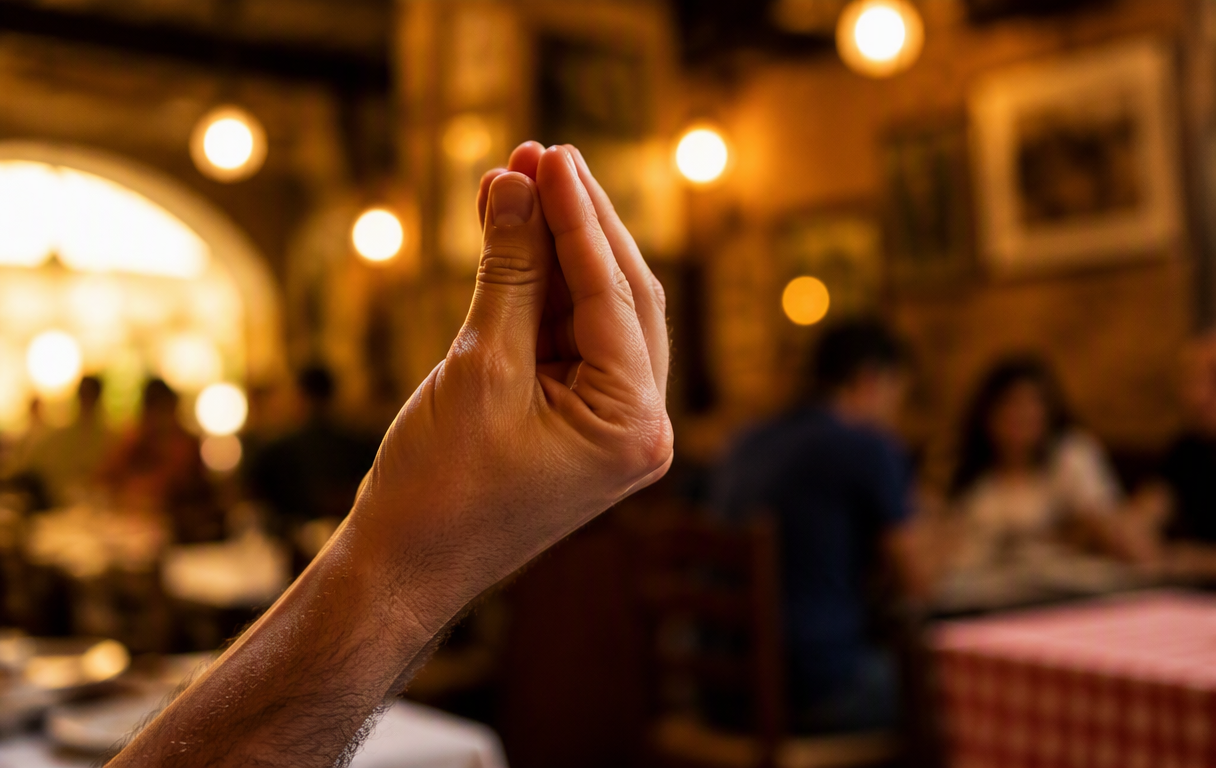
"Ma che vuoi" — the most iconic gesture, made with a closed hand, fingers together pointing upward, shaking at the wrist. It means something like "what do you want?" or "what are you talking about?", generally used with a tone of impatience, surprise, or questioning. It's probably the most imitated Italian gesture outside of Italy.
"Perfetto" — made by joining the fingertips in a shell shape near the lips, sometimes accompanied by a symbolic kiss in the air. It indicates that something is excellent, whether it's a meal, an idea, or a situation.
"Boh" — consists of shrugging with open palms facing upward, usually accompanied by the expression "boh" itself, meaning "I have no idea" or "who knows." It's one of the most commonly used gestures in everyday life, expressing doubt or lack of knowledge in a casual way.
Gesture of doubt or impatience — similar to "ma che vuoi," but with subtle variations in the intensity of the movement and facial expression, it can indicate anything from mild confusion to clear irritation. The correct interpretation depends heavily on context and the tone of voice accompanying the gesture.
Gestures that can cause misunderstandings
Not every gesture has the same meaning across different cultures, and this can lead to embarrassing situations for Brazilians in Italy. The classic "thumbs up," for example, is positive in both countries, but other signs require more attention.
A common case is the "horns" gesture made with the index finger and pinky raised—in Italy, this gesture has a strong association with marital infidelity and can be interpreted as offensive depending on the context, unlike the more neutral use it sometimes has in Brazil in references to sports teams or fan bases.
Another point of attention involves gestures considered vulgar in Italian culture, such as certain hand movements near the chin or gestures that mimic cutting motions, which can be read as rude or provocative. For those just starting to adapt to life in the country, it's worth observing how locals behave before reproducing gestures learned only from videos or memes.
The best way to avoid faux pas is to observe context: gestures used among close friends in a joking tone can come across completely differently if repeated in a formal setting, such as a job interview or a government office.
Gestures by region of Italy
The Neapolitan tradition of gestualità is perhaps the most studied and celebrated in the country. In Naples, gestures form practically a parallel language, with a repertoire so vast that researchers have already cataloged hundreds of signs with specific meanings, some dating back centuries.
The differences between northern and southern Italy also show up in the intensity and frequency of gestures. Regions like Lombardia and Piemonte, in the north, tend toward more restrained communication, reflecting a lifestyle historically closer to countries like Switzerland and Austria. Regions like Campania, Calabria, and Sicilia, on the other hand, maintain a more effusive gestural tradition, often associated with the more expansive temperament attributed to the south of the country.
Curiosities about these local "gestural dialects" still intrigue linguists: some gestures used in Naples are practically incomprehensible to someone from Milano, just as certain facial expressions associated with gestures vary quite a bit between the islands—Sicilia and Sardegna—and the mainland.
How to use gestures in everyday life in Italy
For those moving to the country or spending longer periods there, understanding gestures helps a lot with everyday communication, especially during the process of adapting to the language. In markets, bars, and casual conversations, a well-placed gesture can complement a still-limited vocabulary and make interacting with Italians easier.
Tourists can also benefit greatly from gestural knowledge. Knowing how to recognize "boh" or "ma che vuoi" helps interpret everyday situations, like a waiter explaining that a dish is sold out or a taxi driver responding to a question about traffic. Anyone putting together tips for their first trip to Italy should include this informal learning as part of their cultural preparation.
For those studying the language, pairing gestures with words tends to make memorization easier and learning feel more natural. Cultural immersion methods, which combine conversation practice with observation of social behavior, tend to produce more consistent results than grammar-only study. It's worth seeking out effective methods for learning Italian that also include this non-verbal component of communication.
Trivia and influence on pop culture
Italian gestures have been a constant presence in film and TV for decades, shaping much of the international stereotype about the "Italian way of being." Characters from classic movies, often Italian-American, cemented in popular imagination the image of the Italian who speaks with their hands, gesturing effusively in any situation, from the most trivial to the most dramatic.
On social media, this tradition has taken on new life. Memes and short videos about Italian gestures circulate widely, often exaggerating everyday situations for comedic effect, but also helping spread genuine aspects of the culture to an international audience.
This type of content, though simplified, reinforces global curiosity about Italy and its peculiar way of communicating, serving as an entry point for those who want to get to know the country's customs more deeply. Anyone who follows news from Italy can see how these cultural elements continue to influence the country's image abroad, decades after they became established in cinema.
Understanding Italian gestures goes far beyond learning curious movements to imitate in videos—it's a way of getting closer to a culture that communicates with its whole body. For those of Italian descent, traveling to Italy, or planning to settle in the country, paying attention to these signs is one more way to understand, in practice, what shapes the identity and daily life of Italians.